When to Publish a Book on Amazon: Seasonality and Dates
On this page
- Why the month you publish matters
- Step 1: Ask whether the niche has a busy time
- Step 2: Find the busy months
- Step 3: Count back to your publish-by date
- Step 4: Look at the whole niche, not one book
- Step 5: Check for a quiet time, and for none at all
- Step 6: Plan the launch around the dates
- A worked example: a Christmas coloring book
- What can go wrong
- How NicheWise does this faster
Some books sell all year. Others sell in a short burst, and a book that arrives after the burst waits twelve months for its turn. A Christmas puzzle book published on 20 December has missed most of its buyers. The same book live in early autumn has weeks to be found, and weeks to collect its first reviews.
So the question is not only "which niche?" but "when?". This guide shows how to find the busy months for a niche, how to count back to a publish-by date, and what to do when a niche has no busy months at all. It is for KDP self-publishers, from a first low content book to a tenth novel. You can do every step in a browser, for free.
If you have not picked a niche yet, start with how to find a book niche that sells. Come back here once you have one or two in mind.
Why the month you publish matters
Amazon shoppers buy books for reasons that follow the calendar. They buy gifts before Christmas, workbooks before the school year, planners before January, cozy mysteries when the evenings draw in. In a niche like that, most of the year's sales land in a few weeks.
Two things follow from that. First, a book needs time to be found. A new book does not appear on page one on the day you press publish. It takes a few weeks to settle in, to collect its first reviews and to climb in the results. If the busy stretch begins the week you publish, you arrive just as it starts to fade.
Second, a late book is not a lost book. It will still sell a little, and it will be ready for next year. But if you can choose, it is better to be live before the rush than during it.
Not every niche has this shape. Plenty of good niches sell about the same every month: handwriting practice, large print puzzles, simple logbooks. For those, there is no deadline, and you can publish whenever the book is ready. Knowing which kind of niche you are in is the first job.
Step 1: Ask whether the niche has a busy time
Before you look at any chart, ask yourself who buys this book and when. A gift book sells before the gift day. A back to school workbook sells in late summer. A tax record book sells around tax time. A fitness journal sells in January.
Some niches have an obvious answer and some do not. "Lined notebook for nurses" might sell steadily, with a small bump around graduation. "Halloween activity book for kids" will not.
Check it yourself: write down three guesses for when your niche is busiest. You will compare them with what the data shows in the next step. If your guess and the data agree, you have learned the buyer. If they disagree, trust the data and find out why.
Step 2: Find the busy months
The best way to find the busy months is to look at how the books in the niche ranked over time. A niche is busy when its books rank better than usual in the same weeks, year after year.
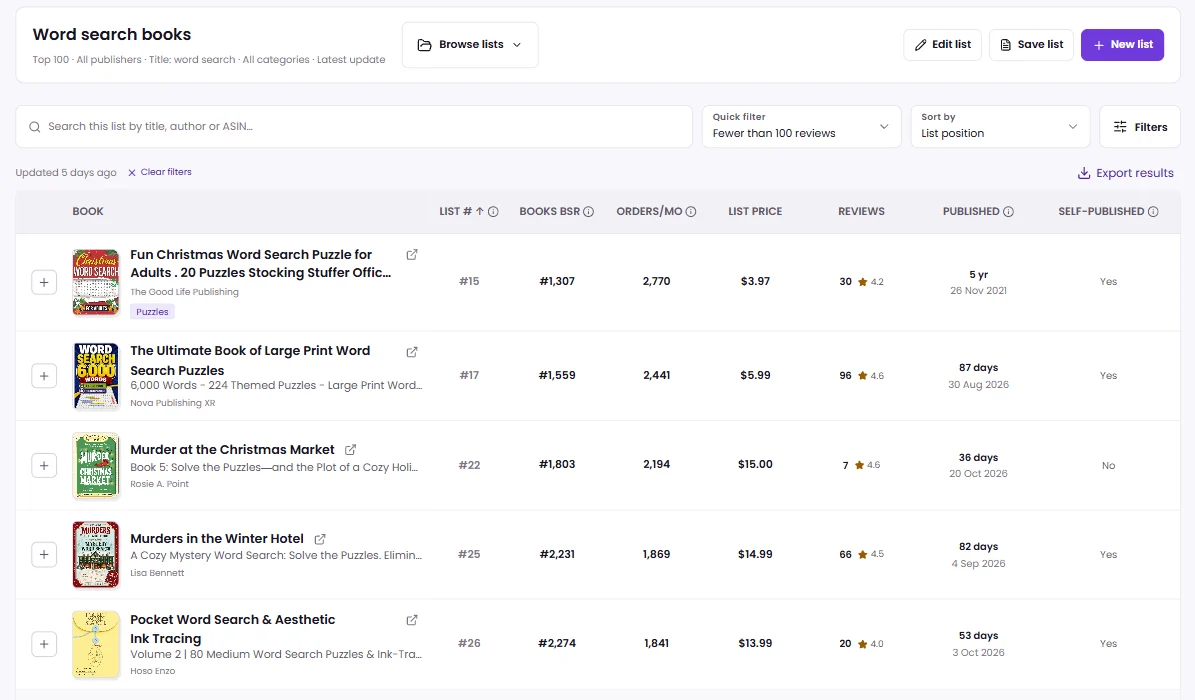
You can do a rough version by hand. Open the top books on page one and look at the dates of their reviews. A run of reviews every autumn and quiet springs tells you when buyers come. Look at the publish dates too: if several of the newest books came out in the same two or three months, other publishers have worked out the timing already.
Rank is a number on each book page, under Product details, called Best Sellers Rank. A lower number is better. If you note the rank of the same five books in autumn and again in spring, you will see which way the niche moves.
Check it yourself: list five top books in your niche. For each one, note the dates of the most recent twenty reviews. Mark the months where the reviews bunch up. Those are the months your buyers are active.
A busy stretch can be short. Two strong weeks count, as long as the books rise in the same weeks in more than one year. A pre-Christmas rush is a good example.
Step 3: Count back to your publish-by date
Once you know the busy months, count backwards. This is the step most publishers skip, and it is the one that matters.
Start at the first busy month. Take away a few weeks, so the book has time to be found and to collect early reviews. Then take away the time it takes you to make the book: writing, design, the cover, proofing and uploading. What is left is your publish-by date.
For a topic that peaks in October, aim to publish by late August. For a Christmas book, have it live by early autumn. If you work slowly or you need a long proof, the date moves earlier, not later.
Check it yourself: write the busy month at the top of a page. Below it, write "live by" and a date a few weeks earlier. Below that, write "cover done by", "text done by" and "start by". If "start by" is already in the past, this year is a stretch, and next year is the realistic target.
Step 4: Look at the whole niche, not one book
A single book can jump up the ranks for its own reasons. Its author may have run a promotion, got a mention somewhere, or changed the price. If you build a plan around one book's chart, you can mistake one book's good week for the whole niche's busy month.
Look at several books in the niche and ask whether they rise together. When they do, the busy months belong to the niche. When only one does, it was that book.
A niche chart is more reliable than a book chart for this reason. It adds up many books, so one odd week matters less.
Check it yourself: pick a month you think is busy. Look at three or four books from page one and see if each of them has more reviews arriving in that month than in the months either side. If only one does, treat the month with caution.
Step 5: Check for a quiet time, and for none at all
A busy month has a quiet one on the other side. Knowing the quiet months is useful too. It tells you when a launch is hardest, and when you can use the slow weeks to prepare.
Some niches have no busy stretch. They look about the same all year, and the chart is flat. That is not a problem. It means there is no deadline. You can publish when the book is ready, and a late book loses nothing to the calendar. If one month is clearly slower, you will see it, but a niche that sells all year is often a good place to build a steady business.
If a niche is new, or has little history, a chart may not have enough to go on. In that case, check again in a month, or look at a wider topic that covers it.
Check it yourself: ask whether the books in your niche sell in January, in June and in October. If the reviews arrive at roughly the same pace in all three, the niche is steady.
Step 6: Plan the launch around the dates
With a busy month and a publish-by date, build the plan backwards.
Pick the date the book goes live. Pick the date the cover and the text are done. Leave a gap for proofing and for any corrections. Put the keywords and the description together before you upload, so the listing is ready on day one. For every step from upload to the first sales, see how to sell books on Amazon. After you publish, check the book page a week later and a month later to see that the listing looks right and the book shows up for the phrases you chose.
If you miss the date, do not rush a weak book out to hit it. A rushed book with poor reviews will hurt you in the busy months it was meant for. Publish it properly, and let it be ready for next year. Meanwhile, use the time to add the extras that help it sell, such as a stronger cover or a better description.
Check it yourself: put your publish-by date in your calendar now, with a reminder a month before it. A date you wrote down is much harder to ignore.
A worked example: a Christmas coloring book
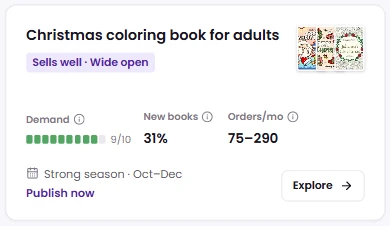
Take a niche with an obvious busy time: a Christmas coloring book for adults. Buyers want it before the holiday, so the busy months sit at the end of the year. The book has to be live before they arrive.
Here is how the steps play out for this niche in NicheWise.
- Busiest months: October to December. The line starts to climb in late summer, peaks in late November and early December, and falls through the rest of December.
- The quiet part of the year: from March to May the line sits near the bottom of the chart. Almost nobody shops for a Christmas coloring book in spring.
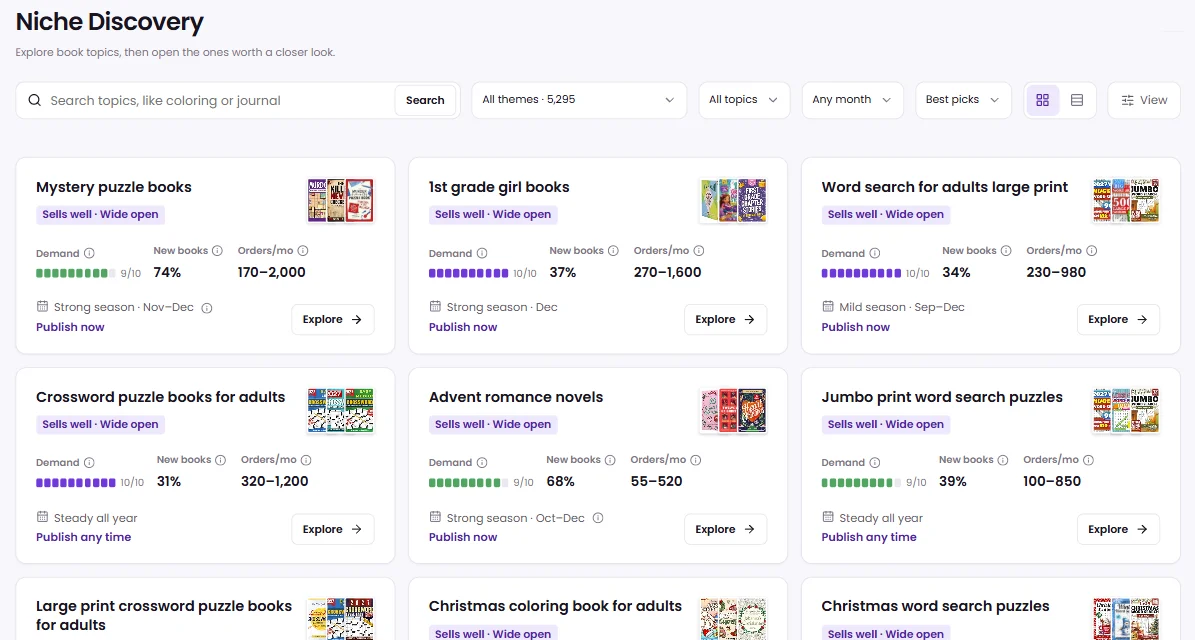
- What the card says: busy from October to December, with a hint under it that changes through the year. Months ahead, it names a date, such as "Publish by early Sep". Early in a busy month it says "Peak now · still time". When the next busy month is only weeks away it says "Publish now", because a paperback goes live in a few days. Late in the rush, a book you have not started yet is a plan for next year.
- The publish-by date: count back from October, as in Step 3. To catch next year's rush, the book should be live by early September, so the pages need to be under way by early summer.
Read the chart first. The line goes up in the weeks when the books rank better than usual, and the busy months are named under the chart. Then count back from the first busy month and write down the publish-by date.
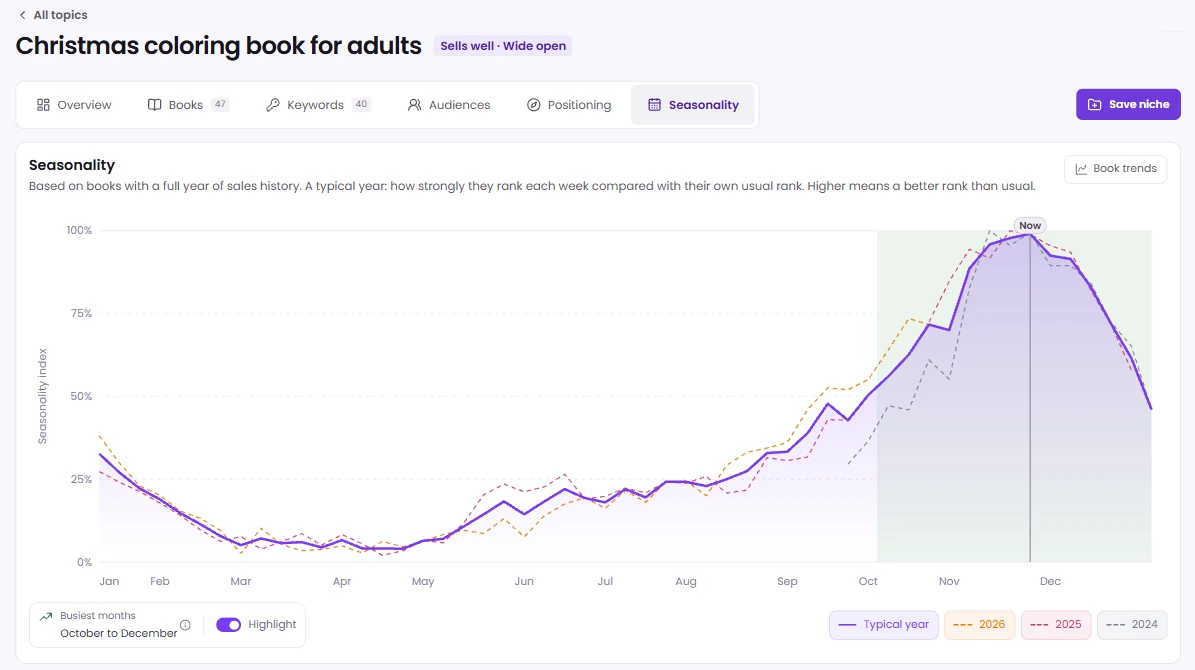
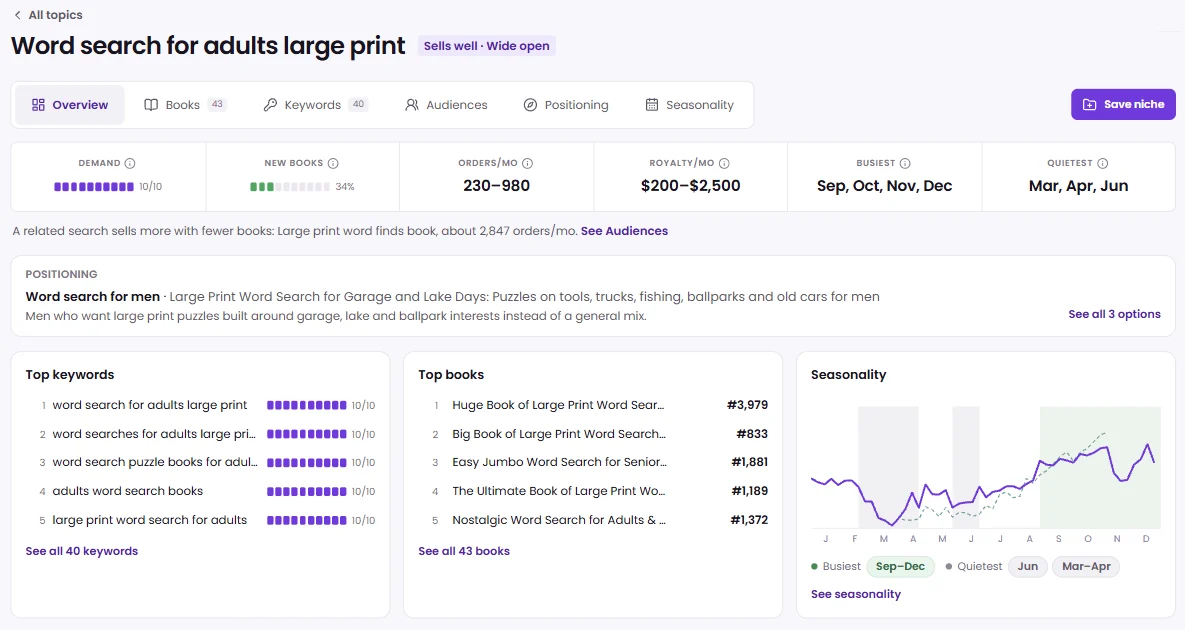
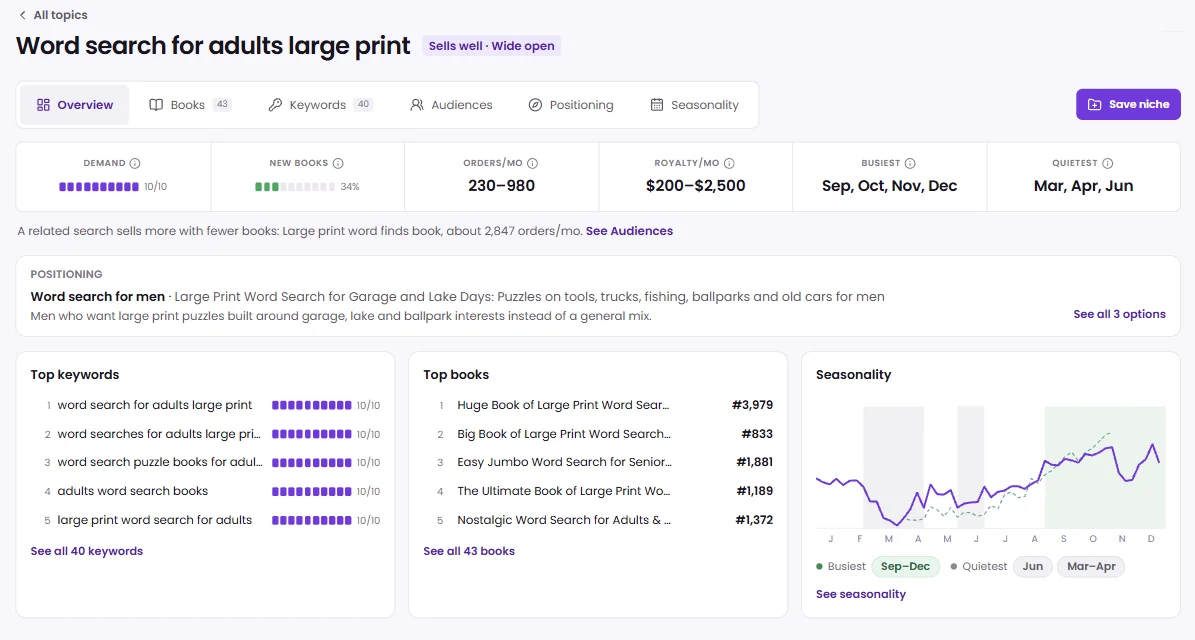
Now compare it with word search for adults in large print, a niche that sells all year. NicheWise still names September to December as its busiest months, and March, April and June as its quietest. The line dips near the bottom only for a few weeks around early April, and holds at about a quarter to a third of the chart through the summer. The Christmas line sits near the bottom from March to May. Its history covers less than two years, so treat the pattern as a guide, not a rule. A word search book can go live in any month, and live by late summer is best, so it has time to settle before the autumn rise.
Two books, two plans. The Christmas book needs a start date set months ahead. The word search book mainly needs to be good.
What can go wrong
A few things trip people up.
Starting too late. The most common mistake is to find out about a busy month in the middle of it. If the busy months are already here, do not rush. Plan for next year, and use the time to make a better book.
Trusting one book. A single book can have a good week for its own reasons. Look at the whole niche before you plan around a date.
Reading too much into a short history. A niche that is new has only a few months of history. A busy month might be a one-off. Check it again later, and prefer a niche where the same months stand out in more than one year.
Expecting the same busy months for a wide topic and a narrow one. "Coloring books" and "Christmas coloring book for adults" do not peak in the same weeks. Check the narrow niche you plan to publish in.
Treating the figures as exact. Every sales figure on Amazon is an estimate worked out from rank. The shape of a chart, with its busy and quiet months, is a good guide to timing. It is not a promise about how many copies you will sell. And a missing figure means no figure was found, never that a book sold nothing.
How NicheWise does this faster
The steps above take time. Reading review dates for five books can take an evening, and you have to repeat it for every idea.
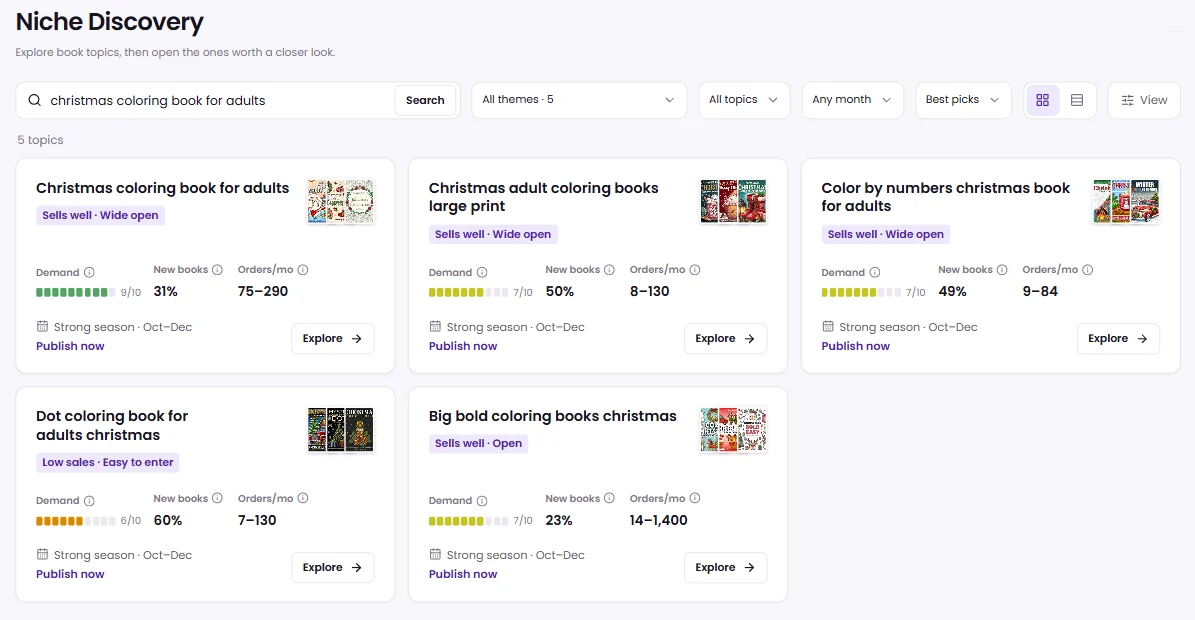
NicheWise does it in one place. On a Niche Discovery card, a seasonality line tells you if the niche has busy months or sells all year, with a hint on when to publish, such as "Publish now" or "Publish any time". Click the card to open the topic page. Its Overview shows the busiest and quietest months, and its Seasonality tab draws the full chart. The line is the seasonality index, from 0% to 100%, and a higher point means the books ranked better than usual that week. The bold line is the typical year, and you can show or hide each year in the key. The Highlight switch shades the busy months.
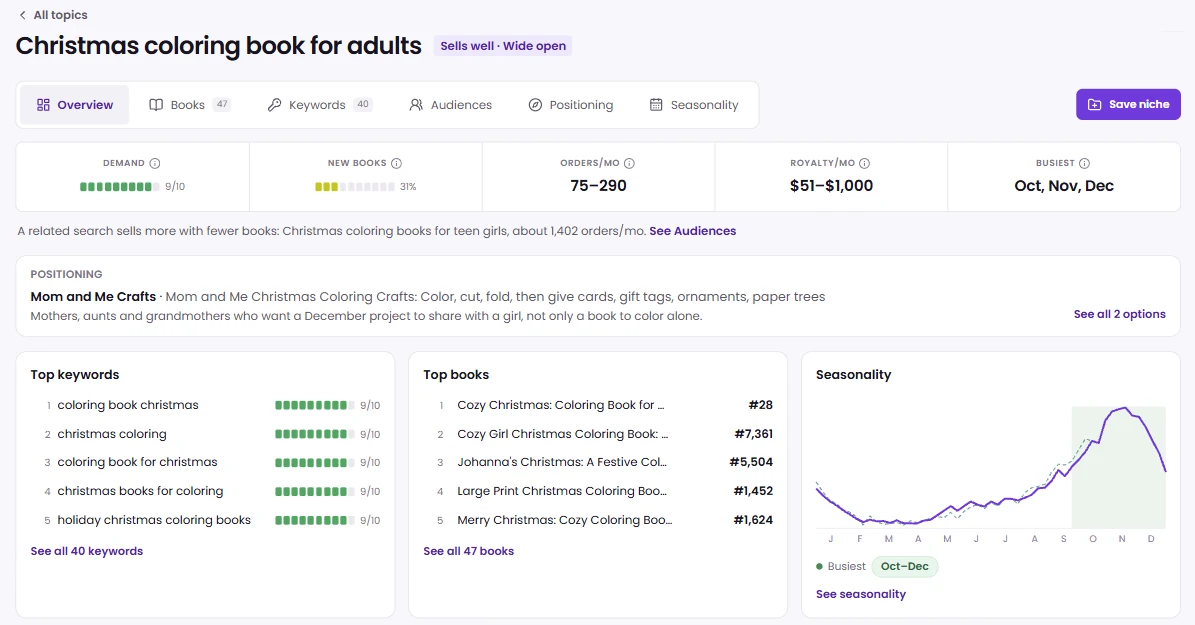
There are three views, and each answers a different question.
- Niche seasonality shows when a whole niche is busy. It builds as you add books to a saved niche in your Niche Library, and it needs at least 5 saved books. If some of them have no history, the Load missing history button fills them in.
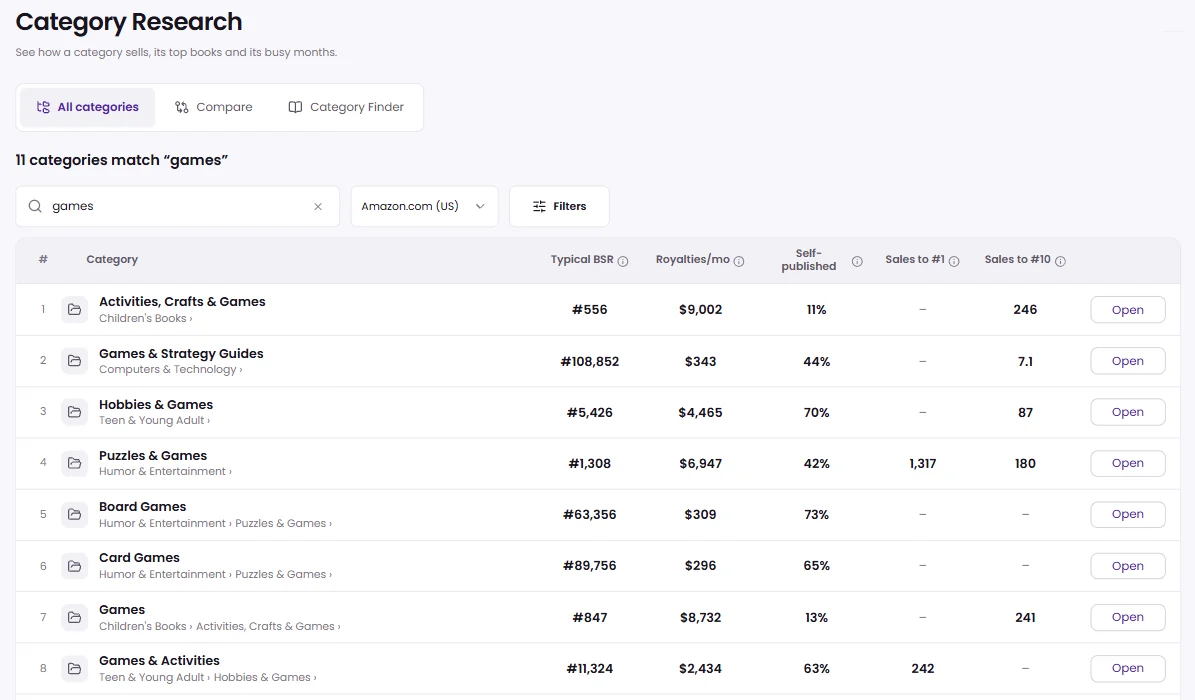
- Category seasonality shows the busy months for a whole Amazon category, which also helps you choose categories. Use it to see the wider pattern behind a niche.
- Book seasonality shows one book's own pattern. Use it to see how a book you are studying behaves, and remember Step 4: one book is not the niche.
On a Free account, the niches you open and this month's picks show Seasonality in full. Pro adds unlimited niche and category seasonality, and all the history for any book. See everything Pro adds on the Pro page.
NicheWise is built for the US store, amazon.com. Try it on the niche you are planning now, and write down the publish-by date before you start the book.