Amazon Best Sellers Rank and Bestseller Lists for Books
On this page
- What does BSR mean on an Amazon book?
- Is a low BSR good or bad?
- What is a good BSR for a book?
- Why you should not trust a single reading
- Can BSR tell you how many copies a book sells?
- How do you read the Amazon bestseller list for books?
- What is the KDP bestseller list?
- Which lists are worth reading?
- A worked example
- What can go wrong
- How NicheWise does this faster
Best Sellers Rank, or BSR, is Amazon's sales rank for a book. Number 1 sells the most. A book at 5,000 sells far more than a book at 500,000. The number moves all day, and it shows how a book is selling compared with every other book on Amazon.
This guide answers the questions self-publishers ask most: what BSR means, what a good BSR is, and how to read the top 100 bestseller lists. It is for anyone on Amazon KDP who wants to judge a niche or a competitor before spending weeks on a book. Everything here you can check in a browser, for free.
What does BSR mean on an Amazon book?
On a book's page, scroll to Product details. You will see a line for Best Sellers Rank followed by a number, like #12,345. That is the book's rank. The lower the number, the better the book is selling.
Amazon updates the rank often, and it reacts to recent sales. A book that sold a few copies today can jump up and fall back tomorrow. This is why one reading of a rank tells you little, and a few readings over a few days tell you more.
You will usually see more than one rank. There is an overall rank for Books, and there are ranks inside the categories the book sits in. The overall rank compares the book with every other book. A category rank compares it with books in that category only, so it is a smaller pond and an easier number to improve. If you want to choose categories for your own book, the guide to KDP categories walks through it.
Check it yourself: open any book on amazon.com, scroll to Product details and write down its overall rank and its category ranks. Look again tomorrow and the day after. Note how far the number moves.
Is a low BSR good or bad?
A low number is good. It is a rank, like a place in a race, so 1 is first. A book at 800 is selling far more than a book at 800,000.
It helps to think in steps, not exact numbers. A rank in the thousands or tens of thousands means a book is selling steadily. A rank in the hundreds of thousands means a book sells now and then. A rank in the millions means a book sells rarely.
Notice how big the steps are. The gap between rank 5,000 and rank 50,000 is large, and the gap between 500,000 and 505,000 is almost nothing. Near the top, a small change in rank means a lot of copies. Far down the list, a big change in rank means almost none. So do not get excited when a book at 900,000 climbs to 700,000. It probably sold one copy.
Check it yourself: search a topic you know, open the first ten books, and sort them into three groups: tens of thousands or better, hundreds of thousands, and millions. Count how many are in each group.
What is a good BSR for a book?
There is no one number that is good for every book. A good rank depends on what you want from the book and what you are comparing it with.
If you are choosing a niche, a good sign is that most of the books on page one sit in the tens of thousands or better. That tells you buyers are turning up. If most of them sit in the millions, buyers are not, and no cover will fix that.
If you are looking at your own book, a good rank is one that keeps getting better as you add reviews and buyers find it. A new book in an open niche can reach a good rank sooner than one in a crowded niche. And a good rank inside a small category counts for something, because it puts your book on that category's list.
Different kinds of books also sell at different ranks. A low content book such as a journal can sell steadily at a rank that would be weak for a novel. Compare a book with others like it, not with every book on Amazon.
Check it yourself: pick a niche and write down the rank of the top ten books on page one. Then do the same for a second niche. The one with more books in the tens of thousands or better has more buyers.
Why you should not trust a single reading
Because the rank moves all day, a single look can fool you. A book can show a great rank because it sold a few copies in one hour, and the same book can show a poor rank on a slow afternoon. This is why NicheWise shows Typical BSR, the book's usual rank over recent days, instead of one moment.
When you check by hand, look at a book on a few different days. If it stays in the same band, you can trust it. If it jumps wildly between the thousands and the hundreds of thousands, it sells in bursts, perhaps because of a promotion or a busy week.
Also look at the whole page, not one book. A single book with a great rank and nine books with poor ones means one book sells, not the niche.
Can BSR tell you how many copies a book sells?
Roughly, but never exactly. Amazon does not share how many copies a book sells, so any copy count you get from a rank is an estimate. Two books with the same rank can sell slightly different amounts, and the same rank sells more in a busy month than in a quiet one.
That is why this guide gives you ranges, not a table that says one rank equals so many sales. The estimates are good for comparing. If one niche's typical book sells about twice what another's does, that gap holds even if the exact numbers are a little off. Do not plan your budget on one figure. For your own books, your KDP report is the exact answer.
In NicheWise, the sales figure is called Orders/mo: about how many orders a month a typical book gets. One order is one copy sold. It looks at the past year, so one busy December does not skew it.
How do you read the Amazon bestseller list for books?
Amazon has a Best Sellers page for books, and inside it a list for each category, showing the top 100 books. Browse down from Books to your category and the list narrows to the books that sell best there.
Read a list in four steps.
Look at the order. Position 1 is the book with the best rank right now. The order changes through the day, so it is a snapshot.
Look at the ranks. Open a few books and read their rank. A list where position 100 still ranks in the tens of thousands or better is a busy one. A list where position 20 already sits in the hundreds of thousands is quiet.
Look at the dates. Check when each book was published. A list full of old books means newcomers find it hard. A list with several recent books means it is open.
Look at the reviews. A list where the top books have a few hundred reviews is easier to climb than one where they all have thousands.
Check it yourself: open the Best Sellers page for Books on amazon.com, go down to a category, and scan the top 20 for rank, publication date and number of reviews. Write down how many are new and how many have fewer than 100 reviews.
What is the KDP bestseller list?
There is no separate bestseller list only for KDP. Amazon's lists include every book, whether it came from a big publisher or from its author. Books published through KDP appear on the same lists as everyone else.
What matters for a self-publisher is which books on a list are self-published, because those show that a new author can win a place there. A list full of big publisher titles is harder to compete on than one where several self-published books sit near the top.
Check it yourself: open a few of the top 20 books and read the publisher line under Product details. Count how many look self-published.
Which lists are worth reading?
Start with the lists closest to your book. A broad list like Books is dominated by a few huge titles, and tells you little. A narrow category list is where you can see what sells to your reader.
Lists are useful in three ways:
- To find competitors. The books at the top of your category are the ones you will sit beside or need to beat. A reverse ASIN lookup shows the phrases they are found for.
- To find gaps. A book with a good rank and a weak cover or a thin description shows where you could do better.
- To check a new idea. If an idea has no books on any list, there may be no buyers, or you may have found something new. Look at the ranks of the books on a search for it to tell which. KDP keyword research shows how to run that search properly.
Check a list more than once. A list read on a Tuesday afternoon and again on a Saturday morning will not be identical, and the books that stay put across both readings are the ones that sell steadily.
A worked example
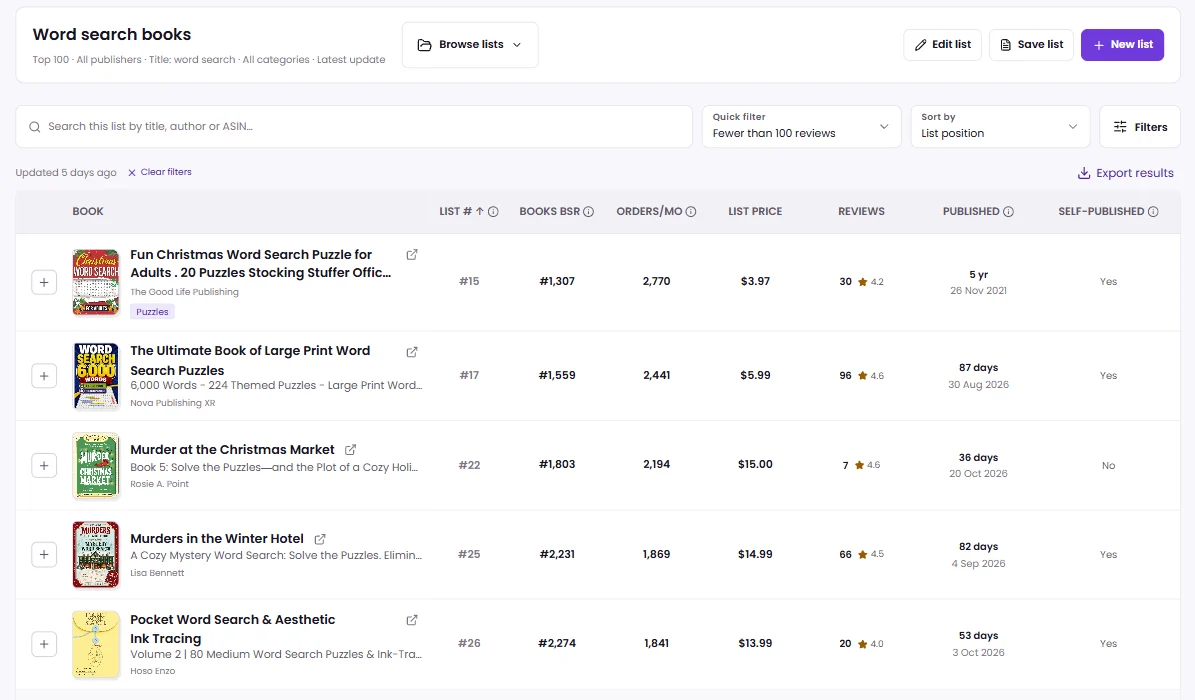
Say you are thinking about a word search book. The Word search books list in NicheWise holds the 100 best ranked books with "word search" in the title. Read with the steps above, it says this:
- The ranks. The 10th book had a rank of #854, the 50th #4,978 and the 100th #10,385. Even the last book on the list sells every day.
- Reviews. 32 of the 100 books had fewer than 100 reviews. A book does not need a wall of reviews to make this list.
- New books. 15 of the 100 came out in the last 6 months, and 14 of those had fewer than 100 reviews. New books are getting in.
- Who publishes them. 46 of the 100 are self-published, but only 2 of the top 10. The very top belongs to bigger publishers, and self-published books hold their own further down.
Whatever the list, the question is the same: is this a place where a book like mine can sell? For word search, the answer is yes: a new self-published book can make this list, though the top 10 is much harder to reach.
What can go wrong
Rank is a snapshot, and sales figures from rank are estimates. A book can look strong because of a one off promotion and weak because of a slow day. Rank also says nothing about the quality of a book or the profit it makes. A book can sell well and earn little if its price is low or its print cost is high. Use rank to compare, and use more than one reading before you decide.
If a figure is missing, it means we could not find it. It never means the book sold nothing.
Once you have a list, a good next step is to check the niche behind it. The guide to KDP niche research shows how.
How NicheWise does this faster
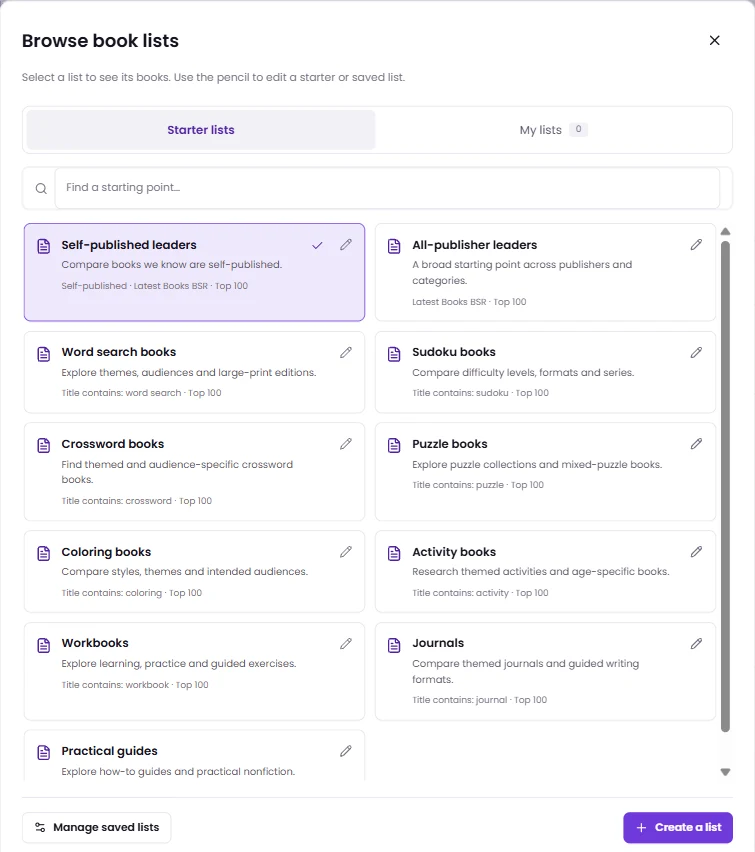
Reading a list by hand means opening book after book. Bestseller Lists puts ranked books in one table. Click Bestseller Lists in the sidebar and it opens on Self-published leaders. Click Browse lists to pick another. Starter lists has topics like Word search books, Coloring books and Journals, and My lists holds the ones you saved.
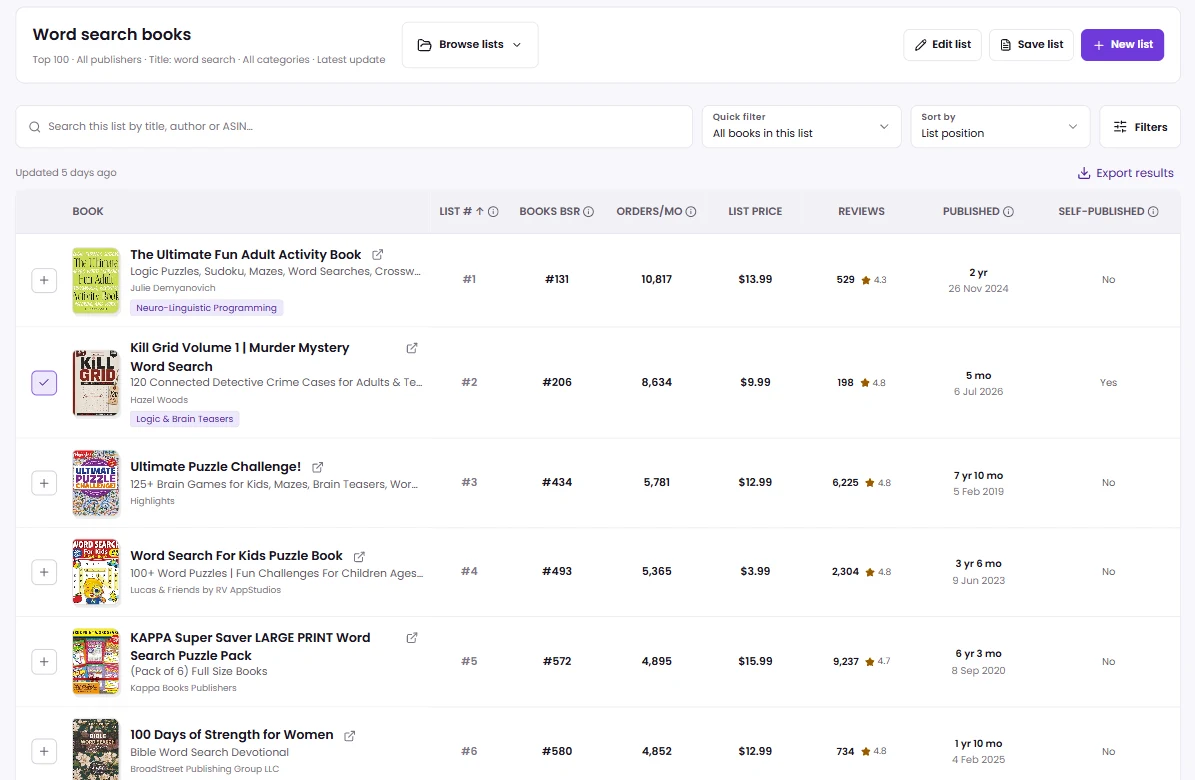
Each row shows List #, Books BSR, Orders/mo, List price, Reviews, Published and Self-published. List # is the book's place in the list, ranked by BSR, and it does not change when you search or sort. A line above the table says when the list was last updated.
To narrow a list, type a title, author or ASIN in the search box. Quick filter has Fewer than 100 reviews and Saved to Niche Library. Sort by covers list position, title, reviews and price, and Filters adds column rules. Click Edit list to change title words, category, publisher and size, Save list to keep it, and Export results to download what you see. Click any title to open it in Book Research.
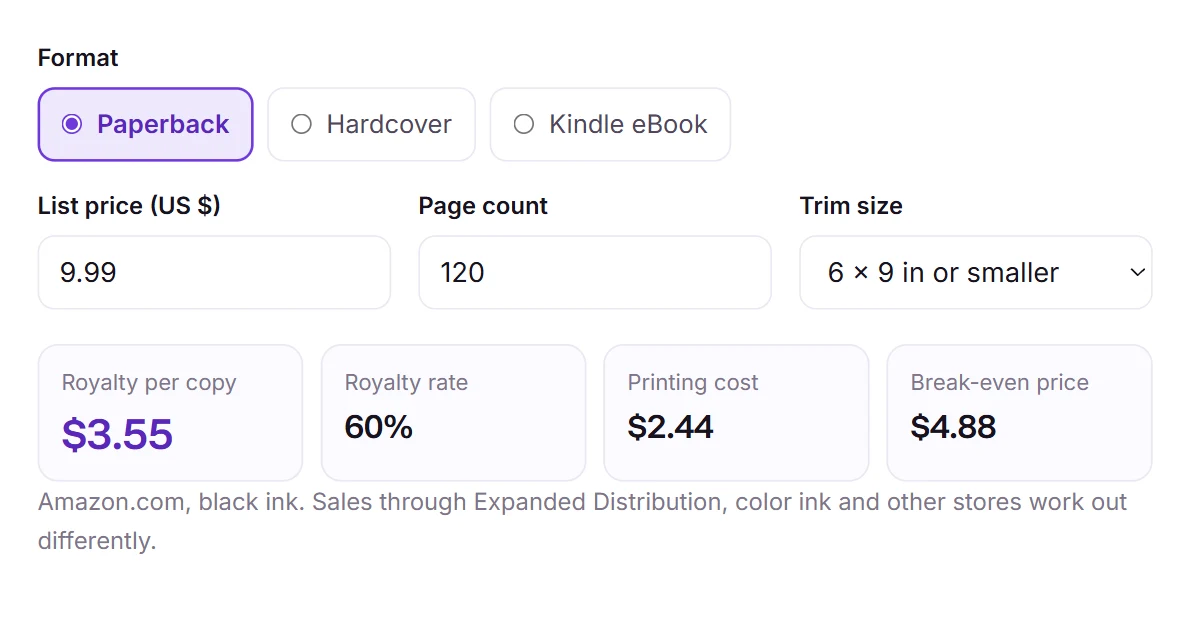
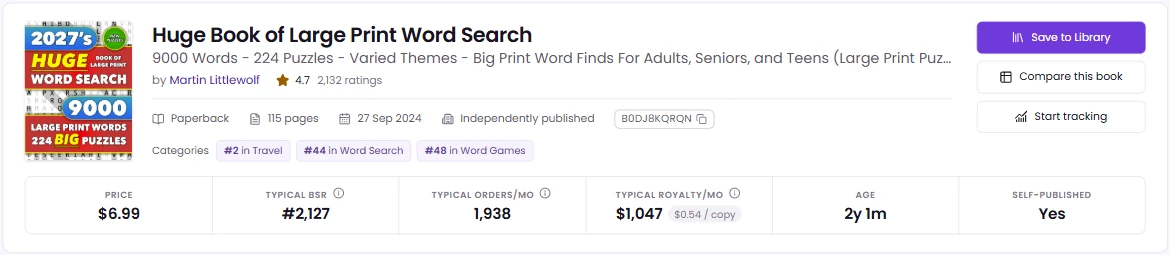
In Book Research, the figures under the title show Typical BSR, Typical orders/mo and Typical royalty/mo, and all three typical figures are estimates from the book's rank. To see what a single sale of your own book would earn, use the KDP royalty calculator. Click Load history, seasonality and reviews to see the rank over time and the busy months. That costs 1 Research credit.
On the free plan, you see the first 10 books of Self-published leaders. Browsing other lists, searching, filtering, sorting and editing are part of Pro.